ICID - What it is
The International Commission on Irrigation and Drainage (ICID) was established on 24 June, 1950 as a Scientific, Technical and Voluntary Not-for-profit Non-Governmental International Organization (NGO) with headquarters in New Delhi, India. The Commission is dedicated to enhancing the worldwide supply of food and fibre for all people by improving water and land management and the productivity of irrigated and drained lands through appropriate management of water, environment and application of irrigation, drainage and flood management techniques. The activities of the Commission are pursued in accordance with the ICID Constitution and By-Laws. Latest version of these was adopted in 1996. English and French are the official languages of the Commission.
Objects and Activities
The Mission of ICID is to stimulate and promote the development and application of the arts, sciences and techniques of engineering, agriculture, economics, ecological and social sciences in managing water and land resources for irrigation, drainage, flood management and river training applications, including research and development and capacity building for achieving sustainable irrigated agriculture.
ICID has half-a-century of experience in the transfer of water management technology and in the handling of related issues. Building on its past experience, accomplishments, and the comprehensive water management framework, ICID strives to promote programs to enhance sustainable development of irrigated agriculture. ICID was involved in the discussions leading to Agenda 21 which has become the focal point of several of its technical activities.
In recognition of its significant contribution to the programs and objectives of International Year of Peace proclaimed by the UN General Assembly, on 15 September 1987 ICID was designated as a Peace Messenger by the UN Secretary General.
The Commission celebrates its Golden Jubilee Year from 24 June 1999 to 24 June 2000.
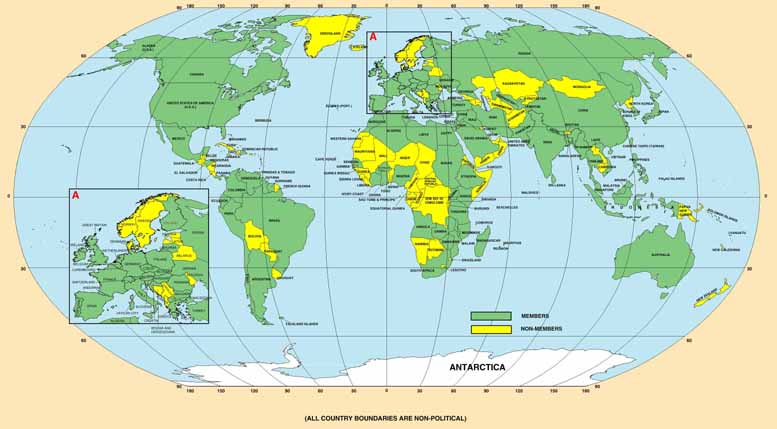
Any geographical area independently administered by a sovereign government and having interest in the activities of the Commission is eligible to become a member, or National Committee. Individual engineers and scientists participate in the activities of the Commission through their National Committees, to further the objects of the Commission in their countries or sovereign areas.
Starting with 11 founding member countries in 1950, 88 countries have joined ICID to pool their efforts. Currently 68 member committees are active participants.
The Office Bearers of ICID are - the President, nine Vice Presidents and Secretary General. The President and Vice Presidents are elected for a term of three years. The Secretary General is appointed on a full time basis for a specified tenure.
The conduct of the Commission’s affairs is vested in the International Executive Council (IEC). The IEC is composed of current Office Bearers and one representative from each National Committee. The Council meets each year.
It is the aim of the Commission that National Committees should be broad-based and multidisciplinary and collaborate with other organizations having related aims in their countries. The National Committees invite and host Commission’s annual IEC meetings, World Congresses held triennially and Regional Conferences held by rotation in the various regions. They also organize activities in their countries to implement various action programs developed, promoted or sponsored by the Commission.
The activities of the Commission are carried out through technical work bodies. National Committees nominate top experts to these work bodies, dealing with various irrigation issues covering the on-farm aspects, development and management of appropriate systems and the socio-economic impacts of irrigated agriculture and land drainage. Currently, there are 28 such work groups. Regional water related issues are addressed by special working groups covering Africa, Europe, Asia, Latin America and the Aral Sea Basin.

A small permanent secretariat, called the Central Office, is located in the Commission’s building on the land provided by the Government of India in New Delhi. The Central Office staff works under the overall supervision of the Secretary-General and a small team of qualified professionals co-ordinate the technical work of the Commission.
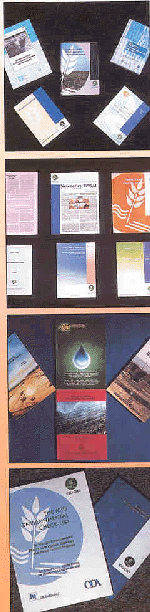
| ICID publishes a peer-reviewed quarterly technical journal (ICID Journal) carrying selected articles, a quarterly Newsletter and a monthly News Update for its members. Special publications are also released from time to time on subjects of interest to the Commission. Some of the publications have received worldwide appreciation. They include A Global Review of Irrigation and Drainage in the World (in three volumes), A Global Review of Flood Control in the World (in two volumes), A Worldwide Survey on Irrigation and Salinity, Environmental Checklist, and ICID-World Bank Guide ‘Planning the Management, Operation and Maintenance of Irrigation and Drainage Systems’. The ICID Multilingual Technical Dictionary (revised in 1996) has been translated into 14 languages. Some publications are also brought out in cooperation/collaboration with other international organizations such as FAO. Recently an ICID-FAO publication on Management of Agricultural Drainage Water Quality, and second ICID report on ‘WatSave Scenario’ have been published. |
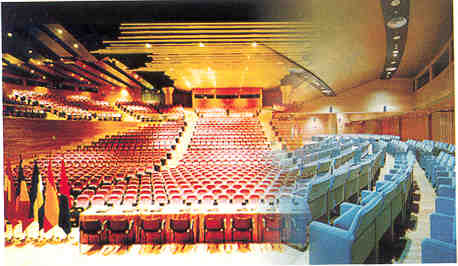
ICID organizes a triennial World Irrigation and Drainage Congress to and annually, by rotation, one of the four regional conferences, namely, African Regional Conference, Asian Regional Conference, European Regional Conference, and Pan American Regional Conference to address and discuss important current, regional and global issues. Through the year 1999, 17 World Congresses, 18 European Regional Conferences, 10 Afro-Asian Regional Conferences, 3 Pan American Regional Conferences and 8 International Exhibitions have been held. Seven International Drainage Workshops have also been organised. Symposia, Seminars and Special Sessions are also held at the time of Congresses and/or IEC meetings and on various other occasions.
Collaboration with UN and Other International Organisations
ICID has a consultative status with the United Nations Economic and Social Council (ECOSOC) and UNESCO since 1954 and with WMO since 1960. UNESCO is a permanent observer in the Commission’s IEC while UNDRO and WMO are represented in ICID’s technical work bodies. The Commission has liaison status with WHO since 1955.
ICID has specialized consultative status with FAO since 1955, and FAO has permanent observer status on the Commission’s IEC.
ICID, World Bank and UNDP jointly sponsored the International Program for Technology Research in Irrigation and Drainage (IPTRID) to enhance priority research and technology transfer, especially in the developing countries. The World Bank is a permanent observer in ICID’s IEC and is also currently represented on more than a dozen work bodies of ICID.
ICID has cooperative arrangements with Regional Development Banks and international non-governmental organizations, such as CIGR, IAHR, IAHS, IWRA, ICOLD, IWMI, WEC, INPIM, etc. It is a founder member of International Union of Technical Associations and Organizations (UATI) since 1950, and has a consultative status of Category A with some of the technical committees of the International Standards Organization (ISO) since 1975.
ICID has a standing Memorandum of Understanding with IWMI since 1993, and with IWRA since 1994. ICID is a founder member of the World Water Council (WWC) and the Global Water Partnership (GWP).
Central Office library houses more than 27000 technical books and receives 150 periodicals. Professionals are encouraged to make use of this library. An annual bibliography of selected references on irrigation and drainage is issued to list accessions to the library as well as information received from the national committees. Quarterly Newsletters and Monthly News Updates provide further current information on water-related activities of the Commission and other organizations.
Annually, a Directory containing the names and addresses of all participating experts, member Committees and cooperating international organisations is compiled. The ICID Website (http://www.ilri.nl/icid/ciid.html) provides all information on ICID and its activities. The quarterly Newsletters, Annual Report and ICID Directory can be accessed on the ICID Webpage, which is presently being hosted on the server of ILRI (The Netherlands). It is proposed to have an independent Server in near future.
ICID has, through its conferences and meetings, addressed the challenges facing irrigated agriculture in the increased competition for water. Official statements and declarations have been issued setting out action plans to promote and increase the conservation of water. WatSave brings together all the major irrigation countries in the world to promote progress in this area. Triennially, N.D. Gulhati Memorial International Award is presented at the time of Congresses to a young professional for the technical contribution in the field of irrigation and drainage. Special WatSave awards for technology, management and for young professionals have been established to recognise irrigation professionals who have made an outstanding contribution to the conservation of water in irrigation. Annually, Hassan Ismail Memorial Award is also presented to a young professional for best paper in African context.
ICID welcomes participation of committed irrigation professionals from all disciplines, and invites all countries to participate in its activities in pursuit of its fundamental objectives.