Outcome
From 18-20 June 2013, the ICID Spanish National Committee (CERYD) along with the Spanish Association on Irrigation and Drainage (AERYD) held their 31st Spanish National Congress on Irrigation and Drainage with the support and at the premises of Orihuela High Technical School, University Miguel Hernandez (UMH). His Excellency Prof. Fernando Villar, Vice-Chancellor of UMH chaired the opening ceremony, and Mr. José Alberto Comos, Director General of Water, Government of Valencia, gave the inaugural lecture, entitled “Irrigation in Valencia: Modernization, Efficiency, Sustainability”.
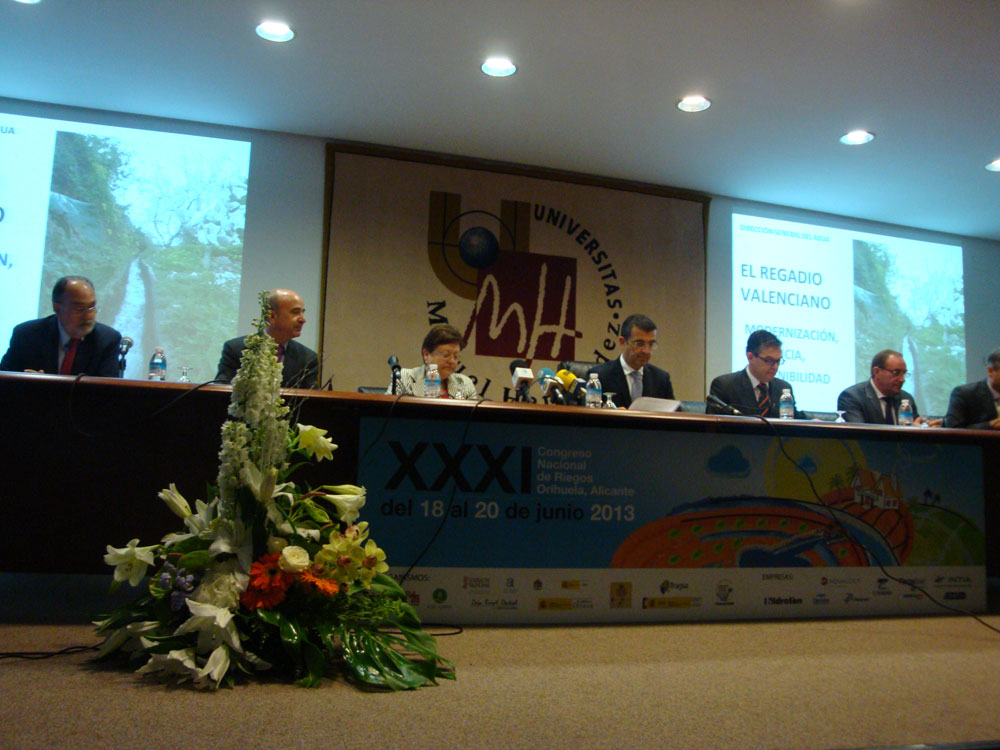
The congress was attended by about 140 participants and 61 technical papers were accepted for discussion on a varied range of issues, directly linked to irrigation, and grouped for discussion in four categories: i) Hydrology, crops water requirements, climatology, effects of climate change; ii) Drainage, salinity, irrigation water and water resources quality, environmental impacts; iii) Irrigation engineering, modernization, water and energy saving, etc.; iv) Irrigation economy, management, farming inputs saving, sustainability, water laws, etc.
From the debates, performed in 10 parallel sessions, came out the following main conclusions:
- The increasing interest to improve the efficiency of the water used by the crops themselves has raised the number of studies on controlled shortfall irrigation, aimed to calibrate crops simulation models so that more efficient strategies on water use can be established to give recommendations on irrigation operation.
- To accurately monitor physiological parameters difficult to be measured as well as to calibrate and tune equipments to obtain reliable data the most advanced technologies are required
- The only way to guarantee the future of irrigated areas is their complete and integrated management in economic, social and environmental terms. Therefore it is recommended to give the final users more participation in the management organs to allow them to contribute their wisdom and experience and accept undesirable decisions.
- Despite the general concern for the accomplishment of the regulations on water quality and the general efforts made to improve irrigation techniques there are still several irrigated areas in Spain where nitrates and other noxious salts exceed the allowed levels in water.
- Special interest arise the quality of underground water, particularly at the Mediterranean coast, because of the doubtful effectiveness and observance of legal reforms passed to improve its quality.
- Although It is demonstrated that irrigation with waste and treated water, if properly managed, yield higher crops, due to the still high prices of waste recycled and particularly sea desalted water, they are so far not used for irrigation as much than would be expected.
- Even though modernization of irrigation schemes have increased the water use efficiency, when it entails the pressurization of irrigation network, the energy consumption and cost raise considerably, to the extent to consider that modernization of irrigation may mean its practical dependence of energy, being its cost a main item of farming accounts, which fully justifies the implementation of efficient management strategies by Irrigators Communities.
- The use of mathematical models to optimize the design of irrigation systems from the viewpoint of saving water and energy can help to optimize the energy consumption of irrigated areas.
- The right selection of emitters and right operation leads to a reduction of costs, due to the use of lower volumes of water, and to minimize environmental impacts in areas of intensive agriculture and sensitive environment.
- The use of shading structures over irrigation ponds improves the quality of stored water, avoiding the entrance of dirt and algae proliferation, which mean important advantages for micro irrigation to avoid emitters clogging.
- The sustainable irrigation management is more and more oriented towards the integrated management of irrigation and energy resources, aiming to improve the environmental and economic efficiency.
- Irrigators Assessment Services continue to be basic at the time to optimize the management of water and energy resources at our irrigation schemes.
During the congress a Round Table was held on the theme “Comprehensive analysis of Irrigation in the lower Segura Basin”, divided into four lectures dealing with 1) History of irrigation of the area since Arab times; 2) Water availability to guarantee irrigation and urban supply; 3) Structures’ modernization plan, and 4) Irrigation as the main driving force in the whole development of the area..
High interest aroused the Special Conference and Session held to make clear the problems caused by the nonexistence of specific regulations for the safety of irrigation ponds, which makes that, currently, the same legislation is still being used either for dams and ponds, which hinders and makes more expensive the construction of such storage structures for irrigation.
The Congress ended with a Field Technical Tour where participants had the chance to thoroughly visit the huge Torrevieja (Alicante) treatment and sea water desalting plant, Europe’s first and world 2nd of capacity, designed to cover the current water deficit for irrigation of 60 Mm3/year and 20 Mm3/year for domestic use in the area, with a present capacity of 80 Mm3/year or 240,000 m3/day, able to be expanded up to 120 Mm3/year according with increasing demands. Then participants visited the Irrigation structures and storage ponds of St. Isidro Irrigators Community and the tour ended with the visit to Hidroten Factory of irrigation equipment, where we were shown the whole interesting process of designing and manufacturing irrigation materials.
|